A setback after a promising result
Italy’s 4-1 defeat to Belgium exposed a gap between the team’s recent progress and its ability to cope when the pressure rises. FIGC Special Commissioner Giovanni Malagò called the loss a wake-up call, while arguing that a return to traditional defending and counter-attacks won’t solve the problem. The scoreline made the result difficult to explain away as a narrow failure of execution: Italy had to confront how its approach held up once the match turned against it.
Italy had beaten France 3-1 at San Siro to top its Nations League group, but the Belgium result ended its hopes of reaching the quarter-finals. A draw would have been enough to advance. That swing in outcomes is a reminder of how quickly a promising run can become a test of consistency, especially when one result carries consequences for qualification.
Progress needs time

Speaking to reporters at the Panchina D’Oro awards, Malagò said the France win shouldn’t be taken as proof that Italy had become a finished product in five or six months. He described the Belgium defeat as an unwanted but useful lesson and urged observers to keep their expectations grounded. One strong performance can show what a team might become; it can’t, on its own, show that the team can repeat that level under different conditions.
“There is an incredible number of Italians watching us,” Malagò said. He added that young players are beginning to emerge as potential figures for the national team, but that their development will take time. That distinction matters: introducing younger players may widen the team’s options, yet their presence doesn’t immediately resolve questions about experience, cohesion or decision-making under pressure.
Old habits won’t address modern demands
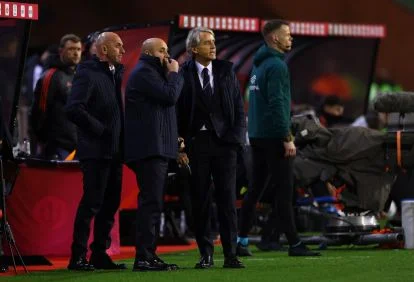
Roberto Mancini’s tactics drew criticism after the loss. Malagò acknowledged that Italy has “60 million coaches,” each with an opinion on how the team should play. Many, he said, want the national side to return to the defensive style and counter-attacking approach that helped define Italian football. That response is understandable: familiar methods offer a clear point of reference after a painful defeat. But familiarity isn’t evidence that those methods will answer the problems exposed by Belgium.
Malagò’s view is that the game has moved on. Today’s football demands technical skill, tactical flexibility and physical capacity. With teams playing three matches a week and the tempo rising, he said, managing those demands has become a central challenge. A side needs to defend effectively, but it also has to make decisions and keep its shape when opponents change the pace or force it to spend long periods without the ball.
His argument isn’t that Italy should abandon tactics. The team should adapt its systems instead of clinging to the past, while still finding ways to offset opponents who are stronger on paper. “When it comes to that aspect, we need lessons from nobody,” he said. The claim is a confident one, and the Belgium result gives critics an obvious reason to ask how that confidence will translate into changes on the pitch.
FIGC election in focus
Malagò is serving as FIGC Special Commissioner ahead of the December 14 election, where he faces former Milan and Monza chief executive Adriano Galliani. Galliani withdrew an appeal over the legitimacy of Malagò’s candidacy amid questions about Genoa’s backing. The election adds an institutional dimension to a difficult moment for the national team: the person speaking about its direction is also operating within a federation facing a leadership contest.
Malagò called the withdrawal a welcome step toward easing tensions. His own first election attempt in June was ruled irregular because paperwork for his candidacy was missing. He said he hoped the campaign could now proceed calmly and with “gentlemanly behaviour.” That appeal points to a desire to lower the temperature around the contest, though the underlying questions about the process have already become part of the story.
What the defeat puts in focus
For Italy, the immediate task is to turn the Belgium defeat into a tactical and developmental lesson. Malagò’s case is for a team that can keep evolving without losing its ability to adjust when a stronger opponent sets the terms. If you’re working in this space, the distinction to watch is whether “adaptation” becomes a practical way to describe changes in how Italy responds during matches, or stays a broad aspiration.
This is more significant than it looks. A team can show progress in one match and still lack the flexibility to manage another; the challenge is making promising performances part of a repeatable pattern. And this is the part most people overlook: a return to an older style might offer reassurance after a heavy loss, but it wouldn’t automatically fix the team’s ability to handle the demands Malagò describes.
There’s no quick verdict in the results so far. Italy’s win over France suggests potential, while the Belgium defeat shows that potential has limits until the team can sustain it against different challenges. A hard lesson. For Malagò, the next test is whether the federation and the team can turn that diagnosis into patient development and more adaptable football.