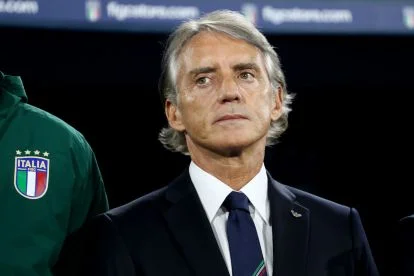
Italy’s talent pipeline needs both better support and earlier tests against senior competition, Massimo Oddo argues. The 2006 World Cup winner says the national team’s recurring problems start below the senior level, as Roberto Mancini prepares Italy for Thursday’s Nations League match against France at San Siro. His diagnosis shifts attention from the pressure on the national team coach to the development system that supplies his players.
Speaking to TuttoMercatoWeb, Oddo said Italy must address the roots of its difficulties if it wants to return to the highest level. He called for young players and coaches to work toward different goals, and for Italian football to give the game more support. The argument is broad, but it points to a practical tension: producing promising youth teams is only part of the job if those players don’t find a credible route into demanding football.
“The talent is there, as the Under-15s and Under-17s show, but it needs backing,” Oddo said. He pointed to factors that can divert young players from development, including regulations, the large number of foreign players and impatience. Those pressures operate at different levels: clubs make choices about squad places, while players and families can feel the pull of quick progress. Oddo’s concern is that the system rewards the appearance of advancement before a prospect has built the habits and experience to sustain it.
In his view, too many prospects expect a fast route up before they’re ready, missing the steady work needed to progress. That’s a familiar problem in youth development: a promising age-group performance can create expectations, but senior football asks different questions about decision-making, physicality and consistency. The bridge between potential and reliable performance takes time. Italy’s challenge, as Oddo describes it, is to make that bridge clearer and more useful.
Earlier senior football could help prospects grow
Oddo’s experience coaching Milan Futuro, the club’s Under-23 side, has reinforced his view that the format can work—but that players often reach it too late. An Under-23 team can offer a step between youth football and a first team, with older and more experienced opponents exposing weaknesses that junior matches may not reveal. Its value depends on when players enter that environment and how closely the level challenges them.
He compared football development with tennis: facing stronger opponents creates room to improve. The comparison is simple, but it gets at the heart of his point. Repeating familiar contests may build confidence, yet it can also leave a player without the pressure needed to adapt. That said, exposure alone doesn’t guarantee progress; the player still needs coaching, opportunity and enough minutes to learn from the experience.
“If Sinner always played the world No 100, he wouldn’t learn anything more, but if he plays Alcaraz, he improves,” he said. Oddo believes many Italian players spend too long in the Primavera before getting senior opportunities. “Abroad, they’re playing first-team football at 17. Here they’re stuck in the Primavera,” he said, describing the delay as years of talent held back. His criticism is less about a single age threshold than about the cost of keeping players in a setting once it stops stretching them.
Earlier promotion carries its own demands: clubs have to judge readiness individually, and a young player needs a role that offers meaningful competition rather than a place on the squad list. Still, the risk of moving too soon shouldn’t obscure the opposite risk. Players can stagnate when the next challenge arrives only after their development has already lost momentum.
Mancini’s latest squad includes teenagers Riccardo Cassano and Simone Lontani. The Italy coach is also trying to persuade Club Brugge striker Nicolò Tresoldi to choose Italy over Germany. Those cases underline the national team’s interest in identifying and securing young talent, but selection at senior level can’t replace the regular competitive experience Oddo says prospects need at club level.
Oddo praises Gattuso’s Lazio
Oddo also singled out Gennaro Gattuso, his teammate in Italy’s 2006 World Cup-winning squad. Lazio are top of Serie A, a run Oddo said he hadn’t expected to see. His surprise lends the praise some weight: he’s describing a team that has changed his expectations through its performances, rather than simply offering a familiar endorsement of a former teammate.
“They have ideas, identity and spirit,” he said. Oddo added that Gattuso knows how to bring the group together when problems arise outside the dressing room. That speaks to a manager’s work beyond tactics: a shared approach can help a side stay coherent when outside pressures threaten to distract it. It doesn’t explain Lazio’s position by itself, but it identifies the qualities Oddo sees behind their run.
What Italy’s development debate means
Oddo’s central point is that talent needs a clearer path into demanding senior football, with support sustained long enough for young players to develop. The debate reaches beyond the design of Under-23 teams. It concerns how clubs, coaches and players decide when a prospect has outgrown youth competition, and whether the next step provides real responsibility.
This is more significant than it looks: youth results can suggest that the raw material is there, while the senior team still needs players prepared for the pace and scrutiny of international football. The gap between those stages is where development systems are tested. If you’re working in this space, the useful question isn’t simply whether a club has a pathway, but whether that pathway gives a player increasingly difficult work at the right time.
And yet, a new team format or an earlier debut won’t solve every problem Oddo identifies. Support, coaching and patience have to accompany the opportunity. The hard part is getting the balance right. A pipeline can produce prospects; turning them into senior players requires a sequence of challenges that keeps moving as they improve.