Roma’s defeat at Old Trafford looks more troubling than its late loss to Real Madrid because the collapse came after a strong first half against a Manchester United side Fabio Capello described as having “average players.” Roma led 2-0 after 18 minutes, then lost 3-2 after conceding three times in the second half. The scoreline captures the reversal; the timing makes it harder to explain away as a brief lapse at the end of an otherwise complete performance.
A fast start, then a sharp reversal
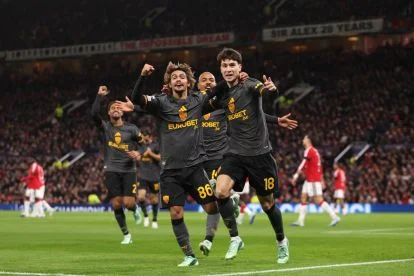
Matias Soulé and Donyell Malen put the visitors ahead, and Roma had chances to extend the margin. That left the team with an opportunity to turn a promising opening into a more secure position, though a two-goal lead can still demand careful management. Instead, the match shifted when Bruno Fernandes scored a penalty in the 58th minute, converting on his second attempt. Matheus Cunha then struck twice, in the 83rd and 86th minutes, to complete United’s comeback.
Those goals came at different stages of the half, but together they changed the meaning of Roma’s first-half performance. The early lead had suggested the visitors could impose themselves at Old Trafford; the finish showed how quickly that control could disappear. A missed chance to add a third might have mattered, but the larger concern is that Roma couldn’t keep United from building pressure after the break.
Different defeats, deeper regret
Alessandro Florenzi, speaking as a Sky Sport Italia pundit, said the Manchester result stung more than Roma’s 4-3 home defeat to Real Madrid. “This one hurts a lot more than Real Madrid, because they conceded three goals in seven minutes, but still played 83 excellent minutes of football,” he said. “In Manchester, they only played one half. There are more regrets here.” His comparison turns on the contrast between two kinds of disappointment: a late defensive failure after a largely convincing display, and a collapse that followed a strong opening but lacked the same sustained quality.
Against Madrid, Roma had led 3-1 entering the 82nd minute before conceding three near-identical goals from corners in a seven-minute spell. At Old Trafford, Florenzi’s criticism was less about one frantic finish and more about Roma failing to sustain its level after a commanding opening period. That distinction matters. A team can take lessons from a specific breakdown on set pieces; losing its grip over an entire half raises broader questions about how it responds when an opponent changes the match’s rhythm.
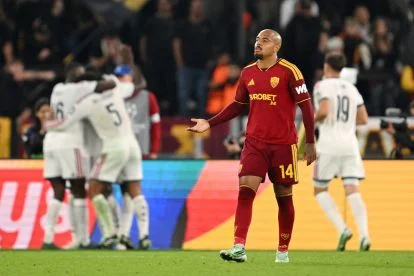
Capello, the former Roma and England manager, was similarly dissatisfied with the performance. He argued that United lacked exceptional players capable of turning a match around in an instant, making Roma’s loss harder to accept. His assessment makes the defeat feel less like an unavoidable consequence of facing overwhelming individual quality and more like a missed chance to control a match Roma had put itself in position to win. The side had not won in any competition since September 10, according to the source account.
A pattern Roma need to break
The Old Trafford collapse adds to a run of Roma leads that have slipped. They were 2-0 ahead against Inter on September 19 before drawing 2-2. Against Udinese, Roma raced to a 4-0 lead after 37 minutes, conceded twice in the second half and eventually won 5-2. Those results aren’t identical: Roma salvaged a draw against Inter and beat Udinese comfortably. But both show that building an advantage hasn’t always meant the match is settled.
That distinction is the part to watch. Scoring early can create options, but it also leaves a team needing to manage the next phase: keep attacking with purpose, protect possession, or defend with enough discipline to prevent the opponent from gaining momentum. The source account doesn’t establish which choices Roma made at Old Trafford. Still, the repeat pattern makes game management a fair question, rather than treating each lost lead as an isolated accident.

United’s record adds pressure
United’s history makes a two-goal lead an especially fragile cushion. No team has completed more two-goal comebacks in the Champions League, and three of its four such recoveries have come against Italian opposition: Roma at Old Trafford, Atalanta in October 2021 and Juventus in the 1999 semi-final. United also overturned a 2-0 deficit against Sporting Braga in October 2012.
That history offers context, but it doesn’t explain the match on its own. A record of recoveries can make a comeback feel familiar to United and warn opponents against assuming a lead will hold; it can’t account for Roma’s decisions or performance after the interval. This is more significant than it looks: the result connects a recurring weakness in Roma’s recent matches with an opponent that has repeatedly shown it can recover from a two-goal deficit.

What Roma must show next
Roma’s recurring problem is its own: leads have repeatedly become openings for opponents to recover. The next test is whether the team can protect control after a strong start, rather than let another advantage unravel. If you’re following Roma, the key evidence won’t be another fast start on its own; it’ll be whether the side can sustain its level once the opposition responds.
That said, one defeat can’t establish exactly why the team loses control, and the available account doesn’t answer every tactical question. The sequence does make the concern plain: Roma has produced strong spells, but the results cited here show that strong spells haven’t always been enough. A lead on the scoreboard. The harder task is making it last.