Venezia’s planned move to the mainland gives the club a long-term stadium home and brings a decades-long debate over replacing its constrained island ground closer to a decision. The club has signed a 40-year agreement with Venice city council to manage the new venue, which is scheduled to open during the 2027–28 season. That timeline makes the project more than a distant proposal, though construction and delivery will determine when supporters can actually use it.
A stadium with uses beyond football
The venue will rise in Tessera, near Mestre, within the Bosco dello Sport complex. It’s designed to hold up to 18,500 people for football and to accommodate concerts, festivals and other major events. That broader programme matters because a stadium used only on matchdays can sit idle for much of the calendar; events could give the site a more regular role in the area. The details of that programme, including how often events will take place, haven’t been specified.
Venezia has committed €125 million, covering completion of the stadium’s facilities, maintenance and the concession fee across the agreement. The figure therefore spans several responsibilities rather than describing only the cost of construction. A 40-year term also gives the club a sustained role in operating the venue, with the associated obligation to maintain it over time. The agreement establishes a long horizon, but the source doesn’t spell out how operating costs or event revenue will be divided.
“Today is a historic day for Venezia FC and our community. The Bosco dello Sport will be our new home,” club president Francesca Bodie said. She described it as “an innovative, inclusive and sustainable stadium of the highest international standards.” Those are ambitious goals, and the practical test will be how the finished venue serves supporters, the club and the wider community. A statement of intent, for now.
Leaving the island behind
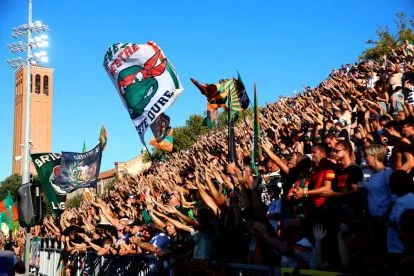
The move will take Venezia away from the Stadio Pierluigi Penzo on Sant’Elena, one of Italy’s oldest grounds. Reached only by boat or on foot, the Penzo’s limited capacity and facilities have long posed challenges for the club. Its setting is part of what makes the ground distinctive, but that same access constraint can complicate the routine demands of a modern football venue. For supporters, leaving means exchanging an unusually intimate island ground for a stadium designed around a larger site and a broader event calendar.
Venice mayor Simone Venturini called the agreement a turning point after years of discussion. “After decades of debates and words, the dream of a modern and functional stadium is finally something we can touch,” he said. The venue, he added, will be home to Venezia FC and “a source of opportunities for the whole area.” His comments frame the project as both club infrastructure and a local development effort, although the available details don’t specify what those opportunities will look like in practice.
What the move could mean
This is more significant than it looks: moving a football club’s home changes more than its address. The new site could make it easier to host larger crowds and non-football events, while the long agreement gives Venezia continuity at the ground. If you’re working in this space, the key question is whether a stadium’s additional uses can support its long-term upkeep without pulling attention away from its main purpose: serving the club and its supporters.
The mainland location also changes the experience of attending a match. The Penzo’s boat-or-foot access is an unusual part of following Venezia; Tessera, near Mestre, will place the club within a different setting, though the source doesn’t describe transport links or travel times. That means the move’s effect on supporters can’t be judged from capacity alone. Access, the atmosphere inside the ground and how the stadium fits into local life will matter too.
The stadium is due to be inaugurated in the second half of the 2027–28 season. Its mixed event programme and mainland location give the project a role beyond matchdays, while the 40-year term ties Venezia’s future to the Bosco dello Sport site. That said, the agreement’s scale makes delivery and day-to-day operation as important as the opening date. The plan has a defined home and a long runway; its value will be measured by how well the venue works once people start using it.