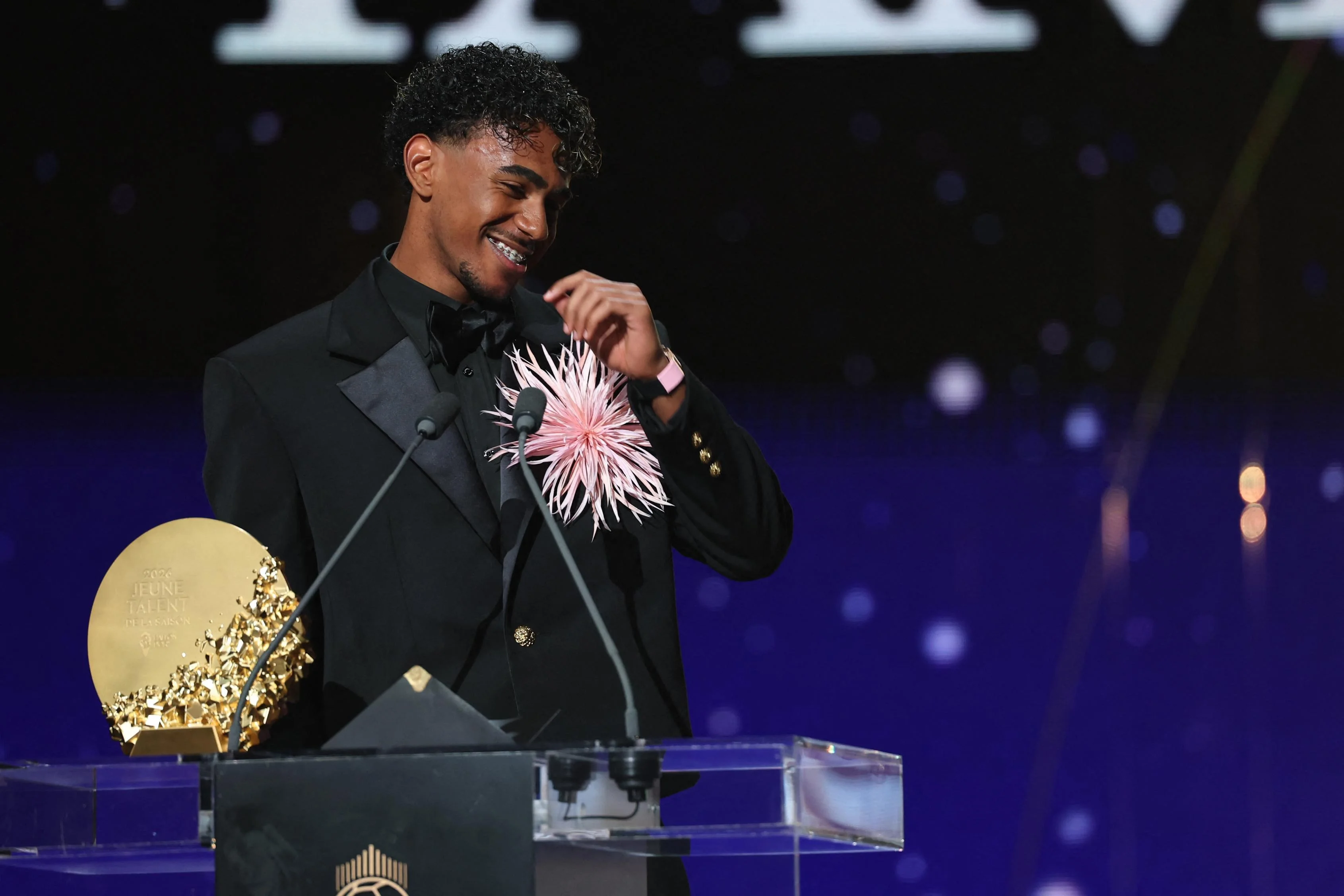
Yamal turns the spotlight toward Cubarsí
Lamine Yamal’s third consecutive Kopa Trophy came with an acknowledgment that shifted attention away from his own achievement: he believes Barcelona teammate Pau Cubarsí should have won. At Monday’s Ballon d’Or ceremony in London, the forward said Cubarsí had been performing at an excellent level for some time. It was a striking qualification from a player receiving one of football’s most visible honors for young talent.
Yamal didn’t dispute the award or minimize what it meant to him. He called it an honour, thanked Barcelona and Spain, and then returned to the case for his teammate. The contrast gave his acceptance speech its shape: a personal milestone, followed by a public argument that the recognition could have gone elsewhere.
That choice matters because awards ceremonies tend to center the winner. Yamal used his moment to draw attention to another player’s work, and he did so in direct terms. He didn’t offer a vague compliment; he said Cubarsí deserved the prize. The gesture reads as both generosity and an endorsement of a teammate whose contribution may be less immediately visible to a general audience.
Two young players, different kinds of contribution
Both players won La Liga with Barcelona last season and featured in Spain’s World Cup triumph in North America, Mexico and Canada. Those shared achievements provide the clearest context in the account: Yamal and Cubarsí were part of successful club and national teams, but the Kopa Trophy could recognize only one player. The award’s individual framing inevitably compresses a season of collective work into a single name.
Yamal is a forward, while Cubarsí’s recognition in Yamal’s remarks is tied to his own performance over time. Their roles bring different demands and different kinds of attention. A forward’s influence can be easier to describe through attacking moments; a defender’s value often depends on decisions and actions that prevent danger before it becomes a highlight. That doesn’t make one role more important than the other. It does help explain why a teammate’s public case for a defender can carry particular weight.
Yamal’s phrasing was also specific about duration. He said Cubarsí had been playing at an excellent level “for some time,” presenting the claim as a sustained judgment rather than a reaction to one match. The source gives no statistics or match-by-match evidence to compare the players, so the remarks shouldn’t be mistaken for a measurable argument about who had the stronger season. They’re an informed teammate’s assessment, delivered on a prominent stage.
An acceptance speech with a second message
“It is an honour to be here and receive this prize,” he said. “I would have liked to see my team-mate Cubarsi here because I think this prize should have been for him. He deserved it. He has been playing at an excellent level for some time.
“This is my third year up here for this prize. I would like to thank my club and my national team. Speaking about this one specifically, this one should have been for Cubarsi.”
The repetition is notable. Yamal raised Cubarsí’s claim near the beginning of his remarks, thanked his teams, and then returned to the same point. That structure makes the praise harder to dismiss as a passing courtesy. He wanted the audience to leave with the idea that Cubarsí’s season merited the trophy, even as he accepted it himself.
Here’s the thing: praise from a rival can sound like campaign language, but praise from a teammate who’s just won the award has a different texture. It can reflect the standards players apply inside a dressing room, where performances are observed across training and competition, not only through the moments that reach a broadcast. (And this is the part most people overlook.) A teammate’s view still isn’t a substitute for the award’s voting process or a complete account of the season. It’s a perspective, offered openly.
This is more significant than it looks. The comments connect individual recognition to the shared work behind Barcelona’s and Spain’s success, while also making room for a player whose contribution Yamal believes deserves more attention. That’s a small but useful reminder of what awards can’t fully capture: the difference between being celebrated and being valued by the people working beside you.
Rest, timing and what the moment says
Cubarsí missed the London ceremony, staying in Barcelona to rest and switch off after a demanding week that included defeats to PSG and Barcelona. The account doesn’t explain his absence beyond that, so there’s no basis for reading it as a statement about the award or its result. It does place Yamal’s praise against a practical backdrop: Cubarsí wasn’t there to make his own case or share the evening with his teammate.
That absence sharpened the personal note. Yamal could have kept his remarks focused on the trophy and the teams he thanked. Instead, he used the ceremony to name Cubarsí and say, twice, that the award should have been his. The choice doesn’t change the result, but it does shape how the night will be remembered by anyone following the pair’s season.
If you’re working in this space, the distinction is worth keeping clear: Yamal’s words are evidence of how he views Cubarsí, not proof that the award was wrongly decided. The article provides no voting details, competing nominees, or criteria that would support a broader verdict. What it does show is a winner publicly sharing credit and making a case for a teammate’s recognition.
And yet, the gesture doesn’t need to settle the debate to matter. Awards offer a convenient story about individual excellence; team sports resist that tidy framing. Yamal’s remarks leave readers with both truths in view: he won a third straight Kopa Trophy, and he thinks Cubarsí should have been standing in his place. A confident acceptance, with an unmistakable note of doubt about who deserved the honor.
One more season’s argument, still open.